The day began with holy adrenaline.
Jesus sent His disciples out to preach repentance and a return to God. He gave them authority—to heal the sick and cast out demons. They felt chosen, powerful, and favored; for the first time, heaven was moving through their very hands.
And they cast out many devils, and anointed with oil many that were sick, and healed them. "Mark 6:13"
When they returned, they poured out their stories like children running to their father—breathless with excitement, eager to show what they had done. It was their first mission, and they were so consumed by the work that they hadn’t even found time to eat.
Then the apostles gathered to Jesus and told Him all things, both what they had done and what they had taught. "Mark 6:30 "
Jesus noticed. He saw their hollow eyes and weary spirits. As the perfect Guardian of peace, He moved to protect them—not only from physical exhaustion, but from something far more subtle and dangerous.
Then, because so many people were coming and going that they did not even have a chance to eat, he said to them, ‘Come with me by yourselves to a quiet place and get some rest. "Mark 6:31"
Jesus wanted them to eat, but even more, He desired to recharge their spirits. He saw a danger in their success that they couldn’t yet spot: the peril of being known by the world as miracle workers. He knew the temptation of being seen, praised, and admired, and the prideful trouble that such attention can bring.
Interrupted Rest, Unexpected Bread
But their rest was interrupted.
Five thousand men—plus women and children—stood between the disciples and their recharge. Instead of rest, they were handed baskets; instead of silence, they faced hunger on a massive scale. As Jesus divinely created bread to feed the multitude, the disciples watched and moved among the crowd, handing out the miracle.
But then, something “immediate” happened. Jesus didn’t let them linger. He “constrained” them—essentially forcing them—into the boat.
And straightway he constrained his disciples to get into the ship, and to go to the other side…”Mark 6:45"
He did not let them linger in the glow of the miracle. While Jesus had compassion on the crowd, He was not distracted by the glory of the moment. This was the first day His disciples had healed the sick, cast out demons, and taken part in feeding a multitude. The crowd would have praised them, admired them, and elevated them. Jesus would not stand by and watch that danger sneak up on His followers; He would not allow that seed of pride to grow.
So, He forced them into the boat, removing them from the applause before it could take root in their hearts.
The Mystery of the Fourth Watch
What follows is striking. The “excitement” of the miracle bread soon turned into the “exhaustion” of a raging sea.
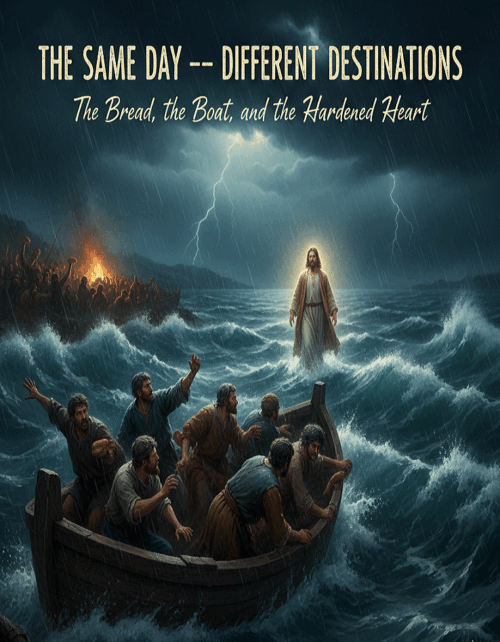
Now when evening came, the boat was in the middle of the sea; and He was alone on the land. Then He saw them straining at rowing, for the wind was against them. Now about the fourth watch of the night He came to them, walking on the sea, and would have passed them by. "Mark 6:47-48"
The storm rose in the evening, but Jesus did not go to them until the fourth watch of the night—between 3:00 and 6:00 a.m. For nearly nine hours, He allowed them to struggle.
Why the delay? Because He was looking for something deeper than their service; He was looking at their hearts.
He had removed them from the danger of the crowd, but now He addressed the danger within. Their young faith had tasted power, and their hearts may have quietly believed what the crowd would have said aloud: We are something now. Nothing strips away the illusion of self-importance like the force of nature. On the shore, they felt like miracle workers; in the boat, they realized they were just men.
But the boat was now in the middle of the sea, distressed by the waves, for the wind was contrary. ”Matthew 14:24"
The Revelation of the “Pass By”
The Bible says Jesus “would have passed them by.” This wasn’t because He didn’t care; it is the same language used when God “passed by” Moses on Mount Sinai. He wanted to reveal His Glory—His divine identity.
He knew they would be scared, and in a way, He was aiming for that. Not to punish them, but to pull back the curtain. He wanted them to see that He wasn’t just a Teacher who provides lunch; He is the I AM who walks on the chaos of the deep.
From Success to Reality
On the shore, the disciples felt strong. After a morning of healing the sick and casting out demons, they believed their own success. They thought they had it all figured out. But the “fourth watch”—the darkest part of the night—brought them back to reality.
For hours, they battled the waves until they were exhausted and broken. Even though they were experienced fishermen, this storm was different. Jesus was preparing them for a greater glory—as the men who would carry His message to the whole world. But that required a heart that knew its true self.
He let them reach the end of their own strength so they would realize that their power and their peace only came through Him.
The Paradox of the Familiar Stranger
There is a jarring, mixed emotion when you realize the person you’ve been walking beside is far greater than you ever imagined.
It’s like being close friends with someone for years—sharing meals, jokes, and casual conversation—only to one day see them walk into a room and realize they hold the absolute power of a King. In an instant, the “friend” you thought you knew is eclipsed by an “authority” you never fully grasped. It’s a moment that makes you both happy and deeply humbled—perhaps even a little scared of how casually you had treated them.
The disciples were comfortable with Jesus. They had walked miles with Him, watched Him sleep, and seen Him eat. They felt they knew Him. But when He came walking across the sea—defying everything they knew about the physical world—they were terrified. They cried out, and a fearful heart is always a humble heart.
When the disciples saw him walking on the lake, they were terrified. “It’s a ghost,” they said, and cried out in fear "Matthew 14:26 NIV"
Jesus immediately answered their cry, comforting their souls with His words:
But Jesus immediately said to them: “Take courage! It is I. Don’t be afraid. "Matthew 14:27"
They weren’t just looking at their Teacher anymore. They were looking at the Creator.
The Hardened Heart and the Loaves
The disciples were accustomed to seeing Jesus perform miracles. Yet, their tired minds failed to grasp the divine meaning of the feeding of the five thousand. They hadn’t just distributed food; they had witnessed creation. This was not something broken being restored, nor half becoming whole. This was nothing becoming something. And yet, when Jesus came to them on the water, they did not recognize Him. They saw a ghost and screamed in terror.
We often think of a “hardened heart” as being evil or rebellious. But here, it describes tired disciples who were simply blinded by the physical world. They saw the bread as a meal, not as a revelation. They understood the food, but they didn’t yet understand the Father.
If they had understood the loaves, they would have looked at the storm and said: “The Hand that just multiplied matter out of nothing is the same Hand that holds these waves.” A heart that understands the Bread does not fear the Storm.
This is the paradox of the Fourth Watch: The One who is close enough to hear your whisper is the same One powerful enough to command the atoms of the ocean.
The disciples finally saw the truth: They realized their “friend” didn’t just have a seat at the table; He owns the house, the land, and the very air they breathe.
Reflection: Beyond the Provision
We are often like the disciples. We experience a miracle—a bill is paid, a sickness leaves, a door opens—and we celebrate the “bread.” We are happy because our needs are met. But our hearts remain “hardened” if we think the miracle is only about the provision.
The miracle is a signpost pointing to the Person. If you are “straining at the oars” tonight, struggling to understand why Jesus is waiting so long to step into your boat, remember the loaves. Remember what He has already done. The storm is not meant to drown you; it is meant to soften the hard places of your heart until you realize that the One who fed you on the shore is the only One who can walk you through the sea.