We often define deception by the wounds inflicted by others—the betrayal of a spouse, the dishonesty of a colleague, or the friend who fractures our trust. We picture deception as something external, something approaching us from across the room.
But Scripture quietly turns the mirror.
The most persistent illusion is not always outside of us; often, it lives within. The danger is not merely being lied to; it is believing the lie when our own heart speaks it.
The Deceitful Heart
The prophet Jeremiah offers a sobering diagnosis of human nature:
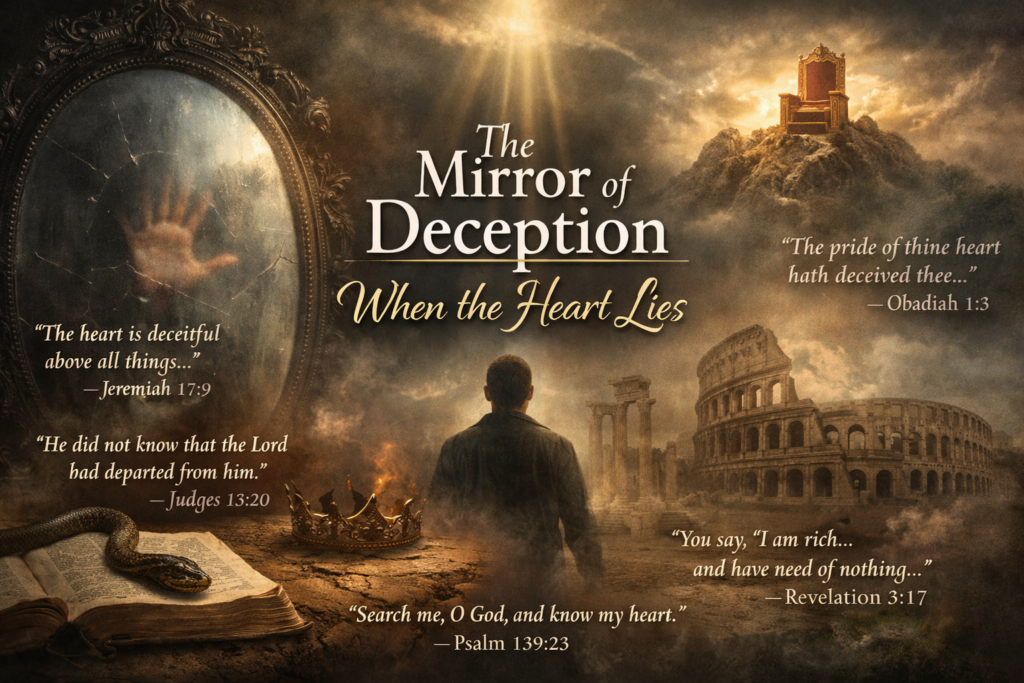
“The heart is deceitful above all things, and desperately wicked: who can know it?” — Jeremiah 17:9
This is not poetry meant to condemn humanity; it is a revelation meant to awaken us. The heart does not simply feel; it provides interpretation and justification. It moves on to convince us we are safe even as we drift. It tells us we are righteous when we wander, and it makes us believe we are wise even when we are blind.
Modern wisdom says, Follow your heart.
Biblical wisdom says, Examine your heart.
Consider an example often seen in recent days: attending a worship gathering where joy, singing, and praise fill the room. Emotions rise, and we are caught up in the atmosphere, clapping and praising along. But when the moment fades, if nothing has taken root, it is like seed falling on shallow ground where birds devour it.
In that same way, all the emotional glow and excitement quickly fades. Yet, in that moment, our hearts can deceive us into spiritual complacency, whispering that we are already transformed, already clean, and already beyond struggle. Our hearts whisper that our sins are gone because we feel good. But in the Scripture, John writes plainly:
“If we say that we have no sin, we deceive ourselves, and the truth is not in us.” — 1 John 1:8
We might also hear the Bible in the church or through a sermon. We often listen with selective hearing—accepting some parts while pushing others away. We deceive ourselves into thinking certain truths don’t apply to us. James expands this imagery:
“Be doers of the word, and not hearers only, deceiving yourselves. For if anyone is a hearer of the word and not a doer, he is like a man observing his natural face in a mirror… and immediately forgets what he looks like.” — James 1:22–24
Here lies the subtle deception: seeing the truth yet remaining unchanged. We may read Scripture or speak holy language, yet walk away untouched. Jesus’ words echo through the generations: “He who has ears to hear, let him hear.” Yet, how often do we truly listen?
When Sincerity Misleads
Scripture repeatedly shows how sincere people misjudge themselves. Peter, full of devotion, told Jesus:
“Lord, I am ready to go with You both to prison and to death.” — Luke 22:33
He was incredibly sincere. His heart believed what it was telling him—that he would follow Jesus to the end. Yet, within hours, fear exposed how little he actually knew himself. His heart had tricked him, and he denied the very One he loved.
Samson’s story echoes even louder. Delilah and the Philistines deceived him repeatedly. Each time he rose and overcame, his success became his expectation. After finally revealing his secret, he rose once more, believing his heart when it told him he would overcome again.
“He awoke out of his sleep, and said, ‘I will go out as at other times, and shake myself free.’ But he didn’t know that Yahweh had departed from him.” — Judges 16:20
Few sentences in Scripture carry such quiet tragedy. He believed yesterday’s power remained today. Deception is rarely a sudden collapse—it is a gradual drift. A heart drifts slowly, and each step away can feel like success until the moment strength fails.
Even David, a man after God’s own heart, was not immune. As a king, his heart deceived him, telling him he could rest while others fought. After seeing Bathsheba, his heart justified actions that led to conspiracy and death. His heart whispered that control belonged to him—that he could command Uriah to be put where the danger was immense so he would die. He lived in this lie until Nathan the prophet awakened him. Only then did David realize how his own heart had deceived him. Upon awakening, he wanted nothing to do with that heart, crying out:
“Create in me a clean heart, O God.” — Psalm 51:10
It was as if he were saying: I cannot trust the heart that led me here.
The Clothing of Devotion
Saul—later called Paul—stands as a sobering example. Educated and disciplined, he walked with full conviction that he served righteousness. His heart assured him he defended the truth, yet he later confessed: “I myself thought that I ought to do many things contrary to the name of Jesus of Nazareth.” He imprisoned believers and approved their deaths, not from a hatred of God, but from a certainty that he honored Him. Jesus’ words to him reveal how deceitful the heart can be:
“Saul, Saul, why persecutest thou me? it is hard for thee to kick against the pricks.” — Acts 26:14
While Saul thought he was doing a service to God, Jesus was knocking and nudging him, trying to wake him up. He kept listening to his own heart, which was proven wrong when Jesus finally appeared to him telling him its hard to keep ignoring His voice. Deception does not always appear as rebellion; sometimes it wears the clothing of devotion. It does not require wicked intent—only misplaced certainty.
The Illusion of Strength
Deception does not only grow in weakness; it flourishes in blessing. Moses warned Israel:
“Beware that you do not forget the Lord… lest when you have eaten and are full… your heart be lifted up, and you forget.” — Deuteronomy 8:11–14
Imagine sailing through violent seas, crying out for rescue. When the calm finally arrives and we are sailing across still water, we often forget to thank the God who calmed the waves. We begin to interpret peace and stability as our own self-achievement. We assume stability is a reward for our goodness rather than an act of grace. Jesus cautioned us that even if we do all that is commanded, we should still say: “We are unworthy servants.”
Centuries later, the church of Laodicea embodied this illusion:
“You say, I am rich…, have become wealthy, and have need of nothing—and do not know that you are wretched, miserable, poor, blind, and naked.” — Revelation 3:17
When Deception Shapes a Life
Heart deception becomes most dangerous when it built on activity rather than relationship.
The parable of the foolish virgins reflects this danger. They appeared ready, lamps in hand, waiting faithfully. They kept themselves pure, yet hidden within was neglect. Oil was lacking. Their hearts assured them all was well—until the moment revealed otherwise, and they heard the voice: “Assuredly, I say to you, I do not know you.”
This deception is most dangerous when people actually talk about God, serve His house, do missionary work, and even perform miracles in Jesus’ name, yet at the end of their lives hear His voice saying: “Go away, I do not know you.” >
Many will say to me in that day, Lord, Lord, have we not prophesied in thy name? and in thy name have cast out devils? and in thy name done many wonderful works? And then will I profess unto them, I never knew you: depart from me, ye that work iniquity. — Matthew 7:22-23
While living day after day doing “wonderful works,” they were, in the Lord’s eyes, working iniquity. How deep the deception!
The Prayer of Clarity
Jeremiah wondered about the heart, asking, “Who can know it?” as though our own hearts and thoughts could become strangers to us. Yet, God Himself answers that question, revealing that He alone knows its depths
“I the LORD search the heart and examine the mind, to reward each person according to their conduct, according to what their deeds deserve.” — Jeremiah 17:10
David understood this and prayed:
“Search me, O God, and know my heart… see if there be any wicked way in me.” — Psalm 139:23–24
Clarity begins when we invite divine examination. Wisdom grows when we seek God beyond our own conclusions. We must lean not on our own understanding, but acknowledge Him in all ways. This is not because the mind is useless, but because it is limited.
Trust in the LORD with all thine heart; and lean not unto thine own understanding. In all thy ways acknowledge him, and he shall direct thy paths. — Proverbs 3:5-6
The mirror of faith does not exist to shame us; it exists to anchor us, reminding us that stability is found not in our perception, but in God’s truth. Our victory is not by the strength of our hands, but by His grace.