There are battles people fight that nobody sees.
A person can look completely fine from the outside — present at work, smiling at church, answering texts — while inside they are exhausted from fighting the same thing again and again. They have promised themselves they would stop. They have prayed. They have resisted. And somehow, they find themselves back in the same place.
For some it is lust. For others, pornography. For others still, a habit or desire that seems to have grown stronger than their ability to resist it — something that started small and now feels like it owns a room in the house they were never supposed to let it into.
And after enough rounds of the same fight, something begins to shift inside.
Maybe I can’t beat this.
Maybe this is just who I am.
Maybe this is permanent.
That voice is one of the most dangerous things a person can believe. Not because the struggle isn’t real — it is — but because it mistakes the weight of the yoke for the identity of the person wearing it.
You are not your burden. And a yoke is not a life sentence.
The Language God Chose
There is a verse in Isaiah that most people walk past without stopping. It sits inside a prophecy about light breaking into darkness, and it uses four words that deserve more attention than they usually get.
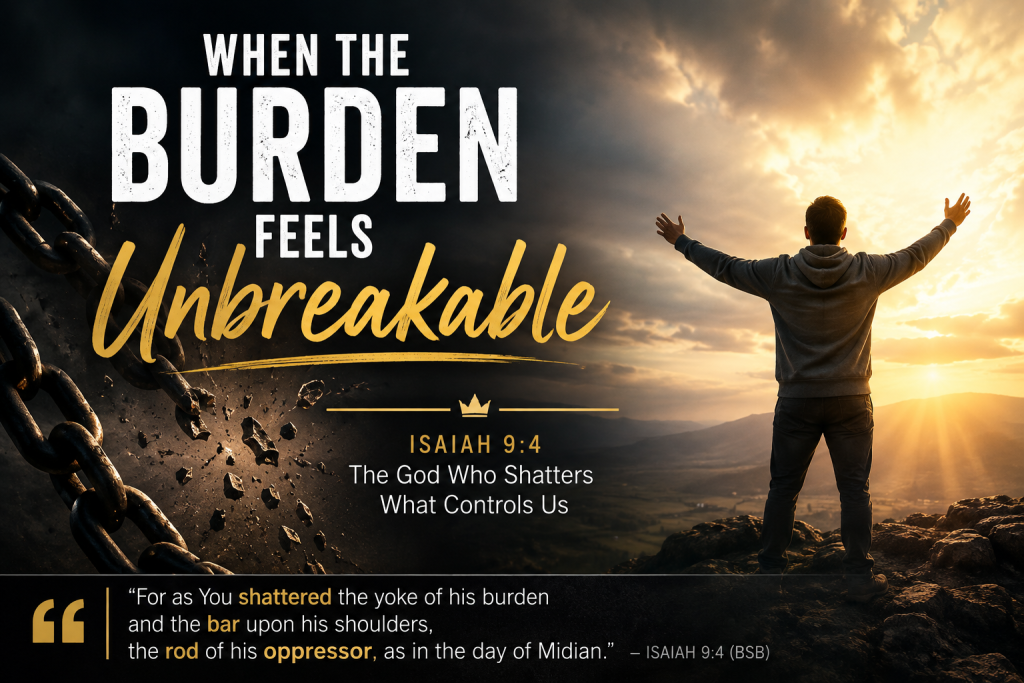
“For as You shattered the yoke of his burden and the bar upon his shoulders, the rod of his oppressor, as in the day of Midian.” (Isaiah 9:4 BSB)
Read those words slowly.
Yoke. Burden. Bar. Oppressor.
God did not choose soft language here. He did not call it a difficulty or a weakness or a tendency. He called it a yoke — something fitted around a neck to control movement. A bar on the shoulders — something pressing down. A rod of an oppressor — something that has been exercising authority over a life.
And here is what matters: God is not surprised by the weight of it. He does not say, Why are you still carrying that? He does not shame the person bent under the load.
He says the yoke can be shattered.
Not loosened. Not managed. Not slowly reduced over years of careful effort.
Shattered.
That word belongs to God, not to willpower. And understanding the difference between the two is the beginning of real freedom.
Gideon: When God Doesn’t Need Your Numbers
The verse in Isaiah doesn’t stop at the promise. It points to a specific moment in history to show what kind of God makes that promise.
“…as in the day of Midian.”
That phrase takes us back to Judges 7 — one of the strangest battle plans in all of Scripture. Gideon starts with thirty-two thousand soldiers. God tells him that is too many. He sends most of them home. Down to ten thousand. Still too many. God reduces the army again — this time to three hundred men — and then He gives the instructions: torches, clay pots, and trumpets. No swords drawn. Just light breaking out of broken vessels in the middle of the night.
The Midianite camp collapsed from the inside. The army was routed not by human force but by sudden, disorienting light in a dark place.
God reduced the army on purpose. He said as much — “lest Israel vaunt themselves against Me, saying, My own hand has saved me.” (Judges 7:2 BSB) He wanted the math to be impossible so that when deliverance came, no one would be confused about where it came from.
This is the God Isaiah invokes when He promises to shatter your yoke.
Not the God who applauds your willpower and then helps you carry the remaining weight. The God who shows up when three hundred torches are all you have and the enemy camp is uncountable — and wins anyway.
You may have already tried willpower. You may have tried promises, rules, accountability, cold showers, deleted apps, and fresh starts on Monday mornings. Some of those things have a place. But there are battles where you eventually arrive at an honest and humbling conclusion:
I cannot save myself from this.
That moment does not have to become despair. In the hands of God, it becomes something else entirely.
Paul: The Thorn That Stayed
The apostle Paul knew what it was to carry something that would not leave.
He had been caught up to the third heaven. He had written half the New Testament. He had planted churches across the ancient world, survived beatings, shipwrecks, and imprisonments. And he had a thorn.
He never names it. Scholars have debated it for centuries. What we know is that he asked God to remove it — three times, specifically — and the answer he received was not the one he asked for.
“My grace is sufficient for you, for My power is perfected in weakness.” (2 Corinthians 12:9 BSB)
Notice what God did not say. He did not say: you haven’t tried hard enough. He did not say: this is permanent, give up. He said something far more radical — that in the very place where Paul could not fix himself, God’s power had room to move.
Paul’s response to this is one of the most countercultural sentences in all of Scripture.
“Therefore I will boast all the more gladly in my weaknesses, so that the power of Christ may rest on me.” (2 Corinthians 12:9 BSB)
He didn’t pretend the thorn was gone. He didn’t hide it. He said: here is where I stop being the answer, and here is where God begins.
That is the posture God is inviting you into today. Not pretending the battle isn’t real. Not claiming a victory that hasn’t happened yet. But arriving at the honest place of I need something stronger than me — and finding out that the One who broke the yoke at Midian is still breaking yokes.
The Broken Pot
There is something worth noticing in Gideon’s battle plan that is easy to miss.
The torches were hidden inside clay pots. Ordinary, breakable, unremarkable jars. And at the moment of battle, the soldiers broke the pots — and the light came out.
The light was always there. But it couldn’t be seen until the vessel was broken open.
There is a version of our struggle that God uses exactly like this. The places where we have been broken — the falls we are most ashamed of, the failures we have hidden from everyone, the battles we have lost more times than we can count — those places do not disqualify us from God’s purposes. They are often the exact locations where His light becomes visible through us in ways that polished, self-sufficient people cannot produce.
Your weakness is not wasted. Your honesty about it is not a liability.
It is the crack in the jar through which the torch can finally be seen.
Come As You Are
If you are in this battle today, the invitation is simple and it requires nothing from you that you do not already have.
Come tired. Come after the fall. Come ashamed. Come when you don’t understand why you keep returning to the same place. Come when you feel like the most disqualified person in the room. Come when the yoke has been on your shoulders so long you have almost forgotten what it felt like to stand straight.
Just come.
Because the promise of Isaiah 9:4 was not given to people who had finally gotten their act together. It was spoken into the darkness of a nation under oppression — people who had no reason to believe anything would change.
And then the yoke was shattered.
Your freedom will not ultimately come from how powerful you become. It will come from discovering how powerful God is — and from placing yourself inside the hands of the One who shatters yokes rather than simply managing them.
The battle is real. The burden is real. The shame of going back is real.
But so is the Deliverer.
And what is immovable in your hands has never once been immovable in His.