The one who overcomes will inherit all things, and I will be his God, and he will be My son. (Revelation 21:7)
For most of my life, I struggled to understand what God meant when He promised the kingdom to “him who overcomes.” If God only rewarded flawless winners, I thought, no one would ever make it.
I believed that winning meant reaching a finish line of perfect holiness — a place where temptation no longer affects you and sin has lost its pull entirely. But holding onto that standard was paralyzing. Because the Apostle Paul himself admitted he had not yet attained it. And if Paul hadn’t reached it, what hope was there for the rest of us?
Not that I have already obtained all this, or have already been made perfect, but I press on to take hold of that for which Christ Jesus took hold of me. (Philippians 3:12)
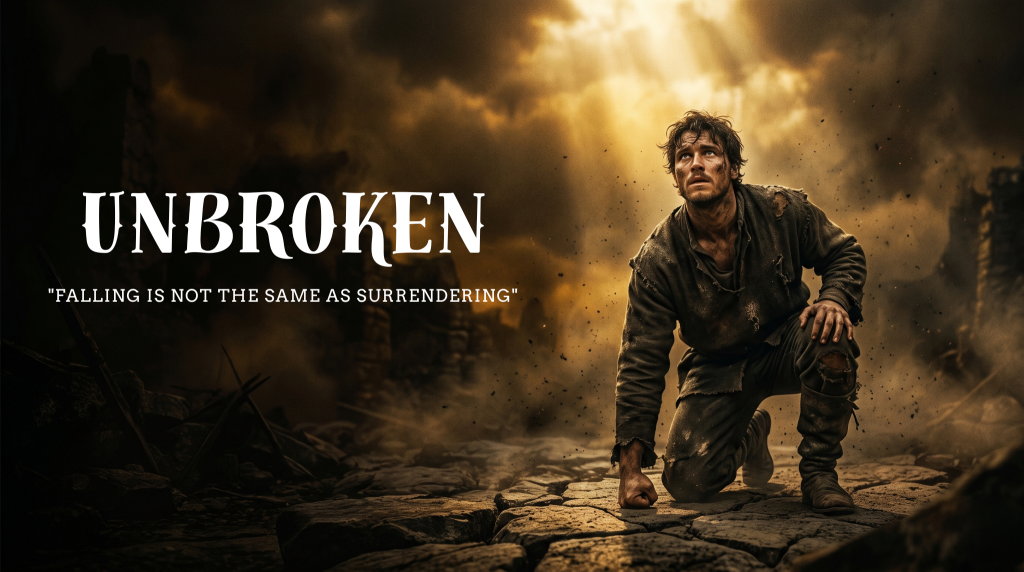
The turning point came from an unlikely place. The 2014 film Unbroken tells the true story of Louis Zamperini — Olympic runner, World War II bombardier, and prisoner of war who endured years of brutal abuse at the hands of a Japanese captor nicknamed “The Bird.” Beatings, starvation, humiliation designed to break not just his body but his will. And through it all, one sentence became his defiance:
“If you can take it, you can make it.”
His captors could not destroy his refusal to surrender. And because he refused to be broken, they lost. The war ended. He walked out. They didn’t break him.
That image changed how I read the Bible’s call to overcome.
Falling Is Not the Same as Surrendering
We must completely redefine how we view defeat. Because defeat in front of the enemy is not about falling into sin once, or twice, or stumbling through an entire season of weakness.
You do not lose the fight by falling. You lose the fight by surrendering.
Proverbs tells us plainly that a righteous man falls seven times — and rises again (Proverbs 24:16). What makes him righteous is not his perfect balance. It is the fact that he gets back up. The fall is expected in a fallen world. The rising is the testimony.
Peter denied Jesus three times in a single night. He didn’t stumble quietly — he cursed and swore he didn’t know the man. And when the rooster crowed and Jesus turned and looked at him, Peter went outside and wept bitterly (Luke 22:61-62). He fell as hard as a man can fall. But he wept. He repented. He came back.
Surrender is something different. Surrender is staying on the ground. It is the moment you listen to the enemy’s whisper that God will not look at you anymore — that you have gone too far, fallen too many times, used up whatever grace was left with your name on it.
Surrender is saying, I am already broken, so what does it matter. And it is in that moment, not the moment of falling, that the enemy wins. When temptation strikes and you fall, the enemy watches what you do next. If you stand back up and cry out to God — even from the floor, even with shaking hands — you send a message that echoes through the spiritual realm: You hit me. But you did not break me.
The Proof of Life in Your Pain
There is something important to understand about the weight you are carrying right now.
If you are reading this feeling exhausted, ashamed, overwhelmed by the constant tug-of-war with the same temptation — if there is grief and misery over your own sin — I want you to hear this carefully.
That pain is not evidence that you are far from God. It is evidence that you are close.
A conscience that still aches is a conscience that is still alive. Satan does not only want you to fall. He wants to break that conscience entirely — to reach the place where your sin brings you hollow comfort instead of holy misery. The man who sins and feels nothing has already surrendered something deeper than his behavior. But the man who sins and weeps? He still has a fire burning inside him that the enemy has not been able to extinguish.
The very fact that you are struggling, hurting, and feeling the weight of it proves that something unbroken remains in you. Grace is still working. The Spirit is still present. You have not let go.
The Ones Who Didn’t Let Go
Samson was a man of extraordinary gifts who made catastrophic choices — pride, lust, self-indulgence — until everything was stripped away. His hair was gone. His eyes were gone. He was grinding grain in a prison, humiliated before the very people he was called to overcome. By any measure, he looked finished.
But in the dark, in the ruin of everything he had wasted, Samson prayed one more time. Not a triumphant prayer. A broken one. “Sovereign Lord, remember me. Please, God, strengthen me just once more.” (Judges 16:28) And God heard it. Grace completed what Samson could not. He died trying — and that was enough.
The thief on the cross had no time left to prove himself. No years of faithful service to offer. No reputation to repair. Just a few hours of life remaining and one honest sentence spoken toward the man dying beside him: “Jesus, remember me when you come into your kingdom.” (Luke 23:42) And Jesus answered him with paradise. Not because he had overcome perfectly. Because he had not let go of the only hand that could save him.
These are not the stories of men who reached a tidy finish line. They are the stories of men who kept their grip until grace carried them the rest of the way.
When the War Came Home
Louis Zamperini survived the prison camp. But surviving and living are not always the same thing.
He came home from the war to nightmares, rage, and a bottle he couldn’t put down. The man who had refused to be broken by the enemy found himself being broken quietly, slowly, by the war still raging inside him. His marriage was fracturing. His life was unraveling. He had endured the worst the world could do to him — and was losing the battle inside his own mind.
Then his wife persuaded him to attend a Billy Graham crusade in Los Angeles. He didn’t want to go. He went anyway. And something happened in that tent that no prisoner of war camp had been able to accomplish — he surrendered. Not to the enemy. To God.
He walked out of that meeting and never touched alcohol again. He later traveled to Japan and forgave his captors — including the Bird, who refused to see him. The forgiveness was given anyway. Because unbroken does not mean unscathed. It means refusing to let what was done to you have the final word.
That is the deeper meaning of the word. Not that you never bled. But that you never stopped belonging to the One who could heal it.
What Winning Actually Looks Like
We cannot read the Bible’s call to overcome as an invitation to arrive at some elevated state where the battle no longer costs us anything. Winning is the endurance of the journey itself. It is holding on through the night when every part of you wants to let go. It is standing back up after the seventh fall. It is dying while still trying — and trusting that grace completes what we could not finish.
Peter was restored over breakfast on a beach. Three questions, one for each denial, and Jesus gave him back his calling before Peter could finish apologizing (John 21:15-17). The risen Christ did not wait for Peter to prove himself worthy of restoration. He made the fire. He made the bread. He waited.
That is who we are dealing with. A God so deeply committed to the unbroken soul that He meets us at our lowest point not with a verdict but with a meal. Not with a list of requirements but with a question: Do you love me?
Even in the absolute depth of your most shameful moment — when the entire world would turn its face away — Jesus is actively looking for a reason to pull you closer. He is not tallying your failures. He is watching to see if you will turn your face back toward Him.
The Victory Flag
If you are barely standing right now, you do not need a grand gesture. You do not need to have it together. You do not need to arrive at the throne room polished and presentable.
You simply need to look up.
“Lord, I am tired. I cannot do this alone. I am in misery and I do not deserve Your care — but I need You.”
That prayer, spoken from the floor of your darkest moment, is the victory flag raised against the enemy. It is the declaration that he has not broken what matters most. You are still reaching. You are still turning. You have not let go.
You will not win this battle completely until you are finally released from this earthly body. But victory today does not require perfection. It requires one thing only — that you keep your spirit unbroken and take one more step toward His open arms. That is the true meaning of overcoming. That is how the battle is won.