The Great Misconception of Purity
We have a habit of sanitizing the concept of holiness. When we hear the phrase “pure in heart,” our minds often drift to white robes, to people who have never tasted the bitterness of sin, or saints who seem to have been born with a halo already intact. We think of purity as a “lack” of something—a lack of darkness, a lack of history.
But when we look closely, we find that God consistently discovers pure hearts in places the world has already overlooked. Again and again, He chooses the outsider, the struggler, and the one still searching.
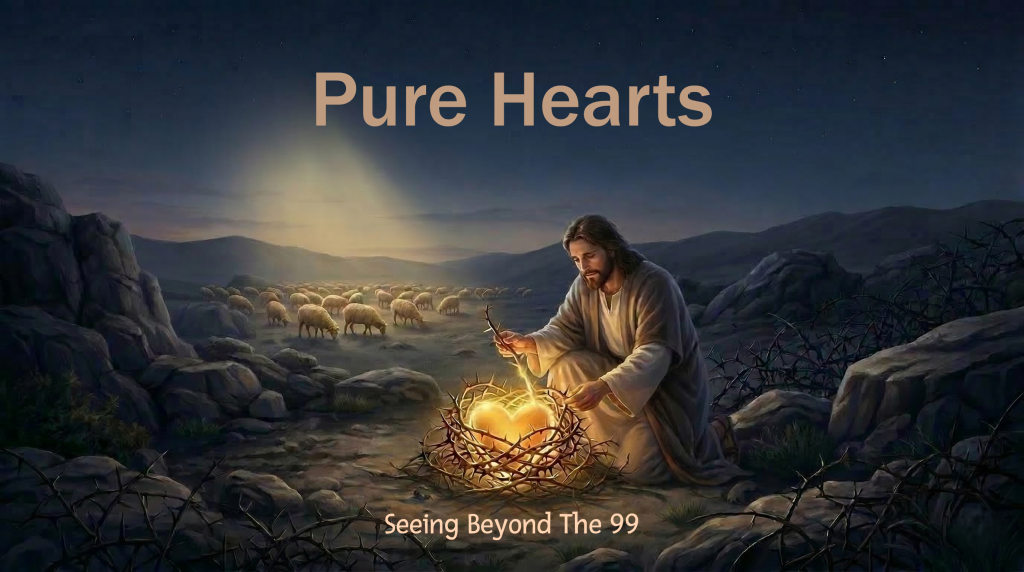
God’s “math” is not our math. We count the sins; He counts the tears of repentance. We look at the 99 sheep who are safe in the fold—those who followed the rules, stayed on the path—and we think, “This is where the value lies.” But the Scripture tells us that God’s heart beats for the One. He leaves the “perfect” 99 to go into the thorns, the mud, and the darkness for the one who is lost.
Why? Because that “one” often possesses a purity that the 99 have forgotten: the purity of absolute need for the father. To God, any heart that seeks Him, regardless of where it is seeking Him from, is a pure heart. It is the heart that has been emptied of its own ego and its own labels, leaving room for nothing but a desperate, singular hunger for the Father.
The Lesson of Nineveh: The Urgency of the Soul
Think for a moment about the people of Nineveh. These were not “holy” people; they were known for their cruelty and their distance from God. When Jonah finally walked through their streets and delivered the message—“In forty days, Nineveh shall be overthrown”—he wasn’t speaking to a choir. He was speaking to a city of “outsiders.”
If you or I were told we had 40 days to live, how would we spend them? Our human nature is to procrastinate. We would spend the first 30 days “messing around,” trying to squeeze every drop of pleasure out of this world, reserving perhaps the final three days to say a quick prayer and “check out” with God.
But the people of Nineveh had a pure response. They didn’t wait until day 39. The Bible tells us that from the King to the cattle, they immediately entered into fasting and prayer. They didn’t bargain. They didn’t ask for a sign. They believed in the power of Jonah’s God because they had likely heard the “sign of Jonah”—the story of a man who survived the belly of a whale. They knew that if God could control the sea and its creatures, He could certainly flip their city. Their purity was found in their immediacy & believe. They didn’t let their ego say, “We have time.” They realized that when the Creator speaks, the only pure response is to listen now.
The Centurion: Purity Through Authority
In the New Testament, we meet a Roman Centurion. By all accounts, he was the ultimate outsider. He was a man of war, an occupier of Israel, a Gentile. Yet, when his servant was sick, he approached Jesus with a heart so transparent that Jesus was “amazed.”
The Centurion declared, “Lord, I am not worthy to have You enter my home. Simply speak the word, and my servant will be healed.” At that very moment, the soldier perceived what the religious leaders failed to grasp. He recognized that Jesus’ power wasn’t confined by physical distance; much like a military commander, he understood Jesus possessed Authority.
God’s Eye: He saw a heart that understood spiritual truth better than those who had studied the Law for a lifetime. The Centurion’s heart was “pure” because it was uncluttered by doubt. He saw Jesus for who He truly was—the Commander of Heaven. Jesus testified that He had not found such great faith, not even in Israel. Purity is the ability to see God’s power clearly when everyone else is blinded by tradition.
The “Dogs” and the Master’s Crumbs
Perhaps the most “heart-touchy” example of an overlooked heart is the Canaanite woman. To the disciples and the culture of the day, she was a “dog”—an outsider, someone beneath the dignity of the Covenant. When Jesus said, “It is not good to take the children’s bread and throw it to the little dogs,” He was revealing the ugliness of the world’s perspective so she could reveal the beauty of hers. He was voicing the exact prejudice she faced every day to draw out to the whole world the gold in her soul.
A heart that isn’t pure would have been offended. A heart full of ego would have said, “How dare you!” But her heart was so focused on the healing of her daughter and the power of Jesus that she accepted the label. She leaned into it: “Yes, Lord, yet even the little dogs eat the crumbs which fall from their masters’ table.”
This is the definition of a pure heart: It is a heart that is too small for pride, but too big for doubt. She knew that even a “crumb” from God was more powerful than a feast from the world.
Cornelius: The Purity of the Devout Outsider
Years after the Resurrection, we see this pattern again in the Book of Acts with a man named Cornelius. He was a Roman officer, yet the Bible says his prayers and his alms “ascended as a memorial before God.”
At that time, Peter and the other Apostles still thought the Gospel was only for the Jews. They were the 99, safe in their understanding. But God’s eye was on the “One” in Caesarea. Cornelius had a heart that was seeking God even though he didn’t have the “right” lineage. God sent an angel to him and a vision to Peter to bring them together.
Why did God go to such lengths? Because Cornelius had a pure seeking. He wasn’t trying to join a religion; he was trying to find The Father. When Peter arrived, Cornelius didn’t ask for a debate; he gathered his whole family to listen. This “outsider” became the first Gentile to receive the Holy Spirit, proving that God doesn’t wait for us to be “perfect” or “included”—He looks for the heart that is already knocking on His door.
When the Story Moves Into Our Time
It would be easy to read these stories and imagine they belong only to the distant past. But God has not changed. The same God who searched the streets of Nineveh and the deck of Jonah’s ship is still searching hearts today. He still surprises us by discovering purity in unexpected places.
1. The Alcoholic Monk (The “Scandalous” Seeker)
St. Paisios of Mount Athos once told a story about a monk who lived in our times. This monk was an alcoholic; he drank every day and was a source of scandal to the pilgrims. When he died, people felt “relieved” that the problem was gone.
Our Eye: We see a failure, a man who couldn’t stay sober, a “bad” monk.
God’s Eye: St. Paisios saw a battalion of angels coming to collect his soul. Why? Because as a child, he was given alcohol to stop him from crying during war, and he became addicted before he could even choose.
The Pure Heart: God saw that this man struggled every single day, praying and weeping to stop. He managed to cut down from 20 glasses to 19, then 18… He died fighting a battle no one else saw. God didn’t judge the addiction; He judged the purity of the struggle.
2. St. Carlo Acutis (The Tech-Savy Purity)
Carlo was a teenager who died in 2006. He loved video games, coding, and the internet. In a world full of distractions, he used his “digital heart” to catalog Eucharistic miracles.
Our Eye: Just a “normal” kid in a hoodie and sneakers.
God’s Eye: A soul who said, “To always be close to Jesus, that’s my life plan.”
The Pure Heart: He showed us that you don’t have to live in a cave to be pure. You can live in the middle of the internet age and keep your heart focused on Him.
The Modern Connection: Anonymous Pure Hearts
Think of the person who has never set foot in a cathedral but spends their nights caring for a sick neighbor with no hope of reward. Think of the “outcast” who has been told they are a “dog” by society, yet they still whisper a prayer to a God they barely know. Think of the seeker who is frustrated by religion but is desperately in love with Truth.
These are the people the world overlooks. We see their mess, their clothes, or their lack of “Christian” vocabulary. But God sees the soil. He sees the 1% of their heart that is open, and He values it more than the 99% of a heart that is closed off by pride. God is still knocking on the doors of bars, hospital rooms, and lonely apartments. He is looking for that sincerity, that “crumb” of faith that says, “I need You.”
To that person, the King of the Universe says: “Truly, you are pure in heart, for you have seen Me.”
Join me in two weeks, where we will look at the “Saints Overlooked”—those whose lives were once filled with darkness, but whose pure hearts transformed them into the greatest lights of the Church. We will see how a murderer, a prostitute, and an addict became the giants upon whose shoulders we stand today.