In our last devotion, we looked at the “Pure Heart” and we dared to challenge the world’s definition of holiness. We discovered that God’s math is not our math—that He isn’t looking for a heart that has never been broken, but for one that has been emptied of its own pride so that He can finally move in. We saw that the “99” are often so comfortable in their safety that they forget what it feels like to be desperate for the Shepherd.
But if we are being honest with ourselves, we still carry a lingering fear. We think, “Surely, there is a limit. Surely, my past, my addiction, or my hidden failures have disqualified me.” We look at the icons on the wall and see golden halos, and then we look in the mirror and see only the shadows.
Today, we will walk through the gallery of the Saints Overlooked. These are the people the world—and often the Church—tried to discard. These are the ones who were called “sinners,” “criminals,” or “lost causes.” But when the light of eternity is turned on, we find that these were the hearts that beat with the purest rhythm of all.
The Rugged Sailors
These were men of the world. They worshipped different gods. They were tough, rugged men of the sea. When the storm hit, and they realized Jonah was running from the God who made the “sea and the dry land,” they were terrified.
But look at their hearts: even though Jonah told them to throw him overboard to save themselves, they tried to save him first. They rowed harder. They fought against the waves to save the man who had brought the disaster upon them. They didn’t even know the God of Israel yet, but they acted with a purity of mercy that many religious people lack. When they finally had no choice but to throw him over, they prayed to a God they were just meeting: “Please, do not let us perish for this man’s life, and do not charge us with innocent blood.” When the world sees rugged, pagan sailors tossed by a storm, God saw those “children’s hearts” in the middle of a pagan ship. He saw their fear, their effort, and their respect for life. The moment Jonah hit the water, God quieted the sea. He didn’t just save Jonah; He revealed Himself to those sailors. The Bible says they “feared the Lord exceedingly” and offered sacrifices. God was knocking on the door of their ship, and because their hearts were pure enough to recognize the Truth, they opened it.
St. Joseph: The Guardian of the Threshold
In all of Scripture, Joseph never speaks a single word. He is the ultimate “man in the background.” He protected the child Jesus and Mary; he provided for his family; he fled into Egypt in the middle of the night. Joseph never preached a sermon. Never performed a miracle. Never wrote a word in Scripture. He disappears between verses.
And yet, he was chosen to raise the Son of God. He protected, provided, and obeyed—without explanation, without recognition. When God spoke, Joseph moved. No questions, no hesitation. And then, he simply disappears from the Scripture.
When the world sees a background character, a carpenter, or a “quiet man,” God saw the man entrusted with the heartbeat of God.
Joseph’s purity was his silence. He didn’t need to be seen. He didn’t need a miracle credited to his name or a sermon recorded in a book. His purity was the ability to be a “shadow” so that the Light could shine more brightly. He is the patron of every father who works any job to provide for a family he loves; he is the saint of every person who does the “quiet thing” that no one will ever applaud. Silent obedience is truly great.
St. Mary of Egypt: The Hunger for the Infinite
For seventeen years, Mary was a woman of the streets in Alexandria. She wasn’t just “living in sin”; she was a hunter of it. She used her beauty as a weapon to draw others into the same darkness she lived in. If you saw her in Alexandria, you would have looked away. You would have judged her as “unclean.”
But when the Holy Spirit stopped her at the door of the church, her heart didn’t harden—it broke. In that moment, the “pure heart” wasn’t the one that had never sinned—it was the heart that stopped lying to itself. Mary didn’t just “try to be better.” She fled. She spent forty-seven years in the desert alone. She traded the noise of the city for a silence so deep that only God could fill it.
By the end of her life, she was so pure that she didn’t just pray; she levitated. She didn’t just walk; she crossed the Jordan River on top of the water as if it were dry land. Her purity was a “wild” purity. It was the realization that if you are going to love God, you must love Him with the same fire you once used to love the world.
When the world sees a prostitute, a “lost cause,” or a scandal, God saw a soul capable of such intense focus and intensity that the world couldn’t handle.
St. Margaret of Castello: The Beauty in the Unwanted
Perhaps no story stings our hearts more than Margaret’s. She was born blind, with a curved spine, and with one leg significantly shorter than the other. Her noble parents were so “ashamed” of her “imperfection” that they kept her locked in a cell for years, hidden from the public eye. When they finally took her to a shrine to be “fixed” and the miracle didn’t happen, they abandoned her. They left a blind, crippled girl in a strange city and went home.
When the world sees a “victim,” someone broken, or someone who has every right to be the most bitter person on earth, God saw a masterpiece of light.
Margaret didn’t spend her life cursing the parents who threw her away. Instead, she spent it becoming a “mother” to everyone else the world had rejected. She visited prisoners; she cared for the sick; she became the joy of the city that found her. Her heart was “pure” because there was no room for bitterness. She was a child whose own parents didn’t want her, yet she lived as though she were the most beloved daughter of the King—because she was.
St. Mark Ji Tianxiang: The Addict Martyr
Mark is the saint for anyone who has ever felt like a “failure” in their spiritual life. He was a doctor who became addicted to opium. For thirty years, he lived in the cycle of addiction. He would go to confession, try to quit, and fall again. Eventually, his priest, not understanding the biology of addiction, told him he was “unrepentant” and barred him from the Sacraments.
When the world sees a “weak” man, someone who couldn’t “get it together” for God, or a failure, God saw a warrior and a faithful soldier.
Imagine the purity required to stay faithful to a Church that has closed its doors to you. For thirty years, Mark knelt at the back of the church, unable to receive Communion, yet never missing a day of prayer. He died a martyr during the Boxer Rebellion, singing the litanies of the Saints as he went to his death. He died an addict, but he died a giant. His purity was found in his refusal to walk away. He proved that God doesn’t judge the “outcome” of our struggle; He judges the sincerity of the fight.
St. Moses the Black: The Weight of the Leaking Sand
Moses was a gang leader, a man of such immense violence, theft, and fear that people trembled at his name. Even when he tried to join a monastery, he was rejected at first. But something shifted. Repentance took root in a place no one expected. He was a “Saint Overlooked” because he looked at himself as the least of all, and in doing so, became one of the greatest.
One day, when a brother fell into sin and the elders called a council to judge him, Moses refused to go. When they insisted, he showed up carrying a large, old sack filled with sand that had a hole in the bottom. As he walked, the sand leaked out behind him. When they asked, “What is this, Father Moses?” he replied: “My sins run out behind me, and I do not see them… and yet I am here today to judge my brother.”
When the world sees a criminal or a “thug,” God saw a great saint of humility and repentance whose past did not define his future.
The Pattern We Must Not Miss
Across all these lives—the murderer, the prostitute, the addict, the abandoned child, and the silent carpenter—a single truth emerges:
Purity is not perfection.
Purity is transparency. It is the “One” sheep who is stuck in the thorns and cries out, “I cannot save myself!”. God is still finding these pure hearts today in places we often refuse to look:
- He finds them in the recovery meeting where someone admits they are powerless.
- He finds them in the hospital bed where someone offers their pain for the sake of the world.
- He finds them in the “One” who has wandered far away but keeps feeling that tug on their heart to come home.
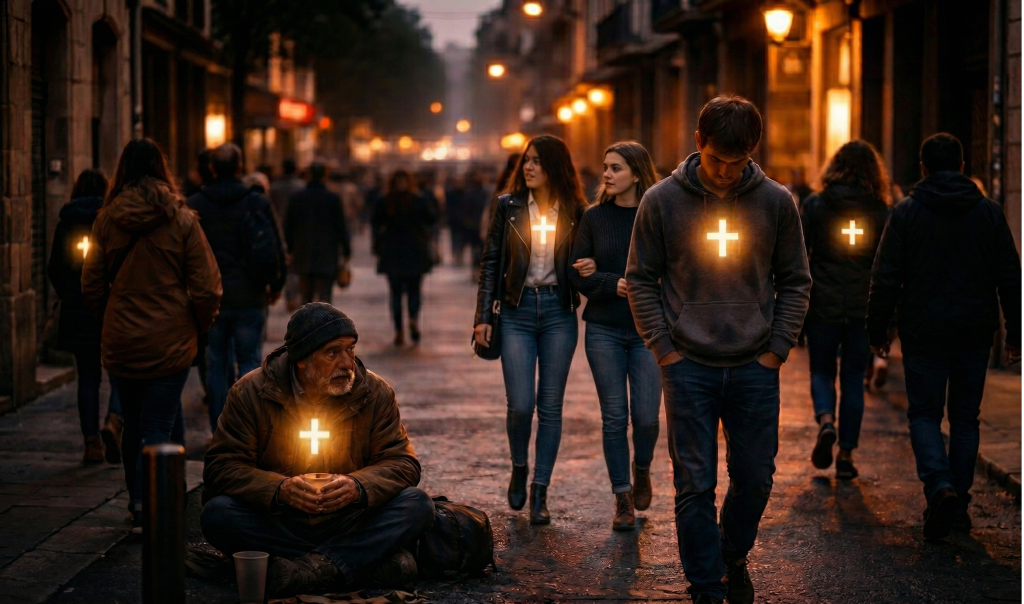
As you walk through your week, remember that you are likely surrounded by “Saints Overlooked.” The person at the grocery store who looks “rough,” the neighbor who seems “lost,” the family member who has “failed” a thousand times—God is looking at them with “His Math.”
And He is looking at you that way, too. You may feel like your life doesn’t “look spiritual enough.” You may feel like your struggle is too messy for a halo. But Heaven has always moved through the overlooked. The question is not, “Do people see me?” The real question is, “Can God trust my heart in the hidden place?”