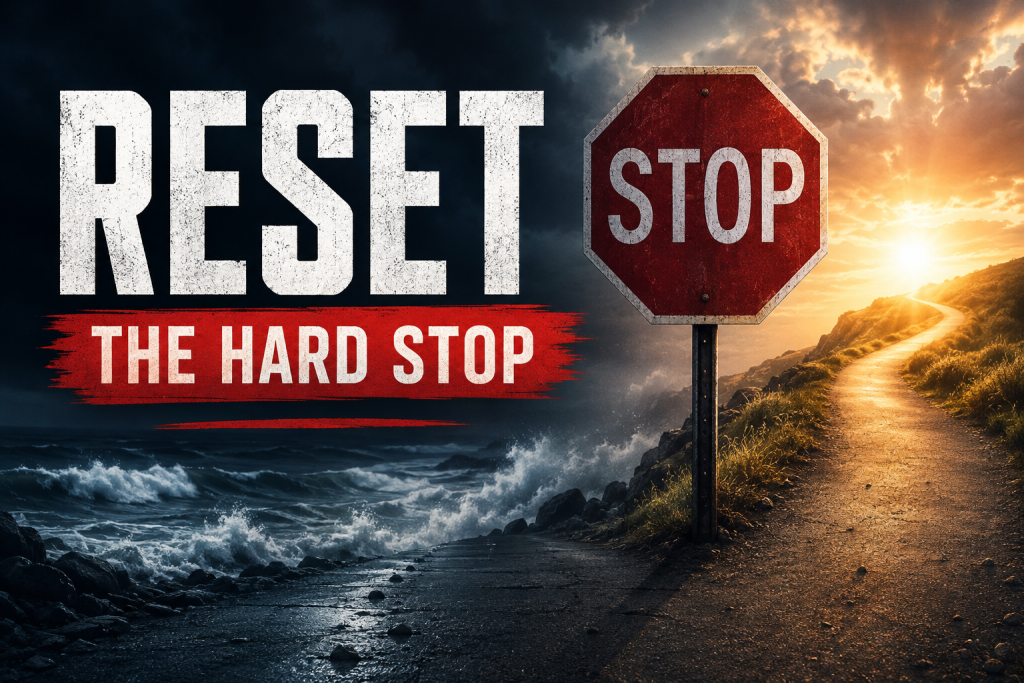
The Hard Stop
Sometimes before you can stand, you have to stop fighting the wrong way.
There are moments when we find ourselves so deep in a struggle that we don’t even know where to begin. Not because we haven’t tried. But because we have tried everything we know — and the waves keep coming anyway.
You are exhausted. You have made promises you couldn’t keep. You have fought hard and fallen again. And the question that surfaces in the quiet, the one you are almost too tired to ask, is this:
Where do I even start?
I once heard something about drowning that changed the way I think about this.
When a person is drowning and a rescuer reaches them, the most dangerous thing the drowning person can do is keep thrashing. The panic, the desperate movement, the wild attempt to save themselves — all of it makes the rescue harder. The rescuer cannot get a grip. The drowning person cannot receive help they are too frantic to accept.
The rescuer has to bring the struggle to a stop before he can bring the person to safety.
That image stayed with me. Because I think many of us are doing the same thing with God.
We are fighting. Fighting temptation. Fighting our thoughts. Fighting our habits. Fighting ourselves. Fighting so hard and so frantically that we don’t realize the One reaching for us is already there — and our own thrashing is making it harder to be pulled out.
Sometimes the first thing God needs from us isn’t another promise to fight harder. Sometimes He needs us to stop.
The Strength to Become Still
There is a verse in Isaiah that has always carried a strange kind of weight.
"For this is what the Lord GOD, the Holy One of Israel, has said: 'In repentance and rest you will be saved, in quietness and trust is your strength.' But you were not willing." (Isaiah 30:15 BSB)
Read that again slowly.
In repentance and rest you will be saved. In quietness and trust is your strength.
We have been taught — by the world and sometimes by well-meaning faith — that strength means fighting harder. Pushing through. Gritting our teeth and going another round. And sometimes that is true. But God offers something here that our natural instincts resist completely.
The strength to stop.
The strength to become quiet.
The strength to release the control we keep trying to maintain and say — God, I cannot keep going in this direction.
That is not giving up. That is a reset.
And notice the last four words of that verse: “But you were not willing.” God had offered His people the counterintuitive path to rescue — rest, quietness, trust — and they ran from it. They ran to Egypt, to horses, to human strategies, to anything that felt more like action. More like strength. More like control.
We do the same thing. We run toward more effort when God is inviting us toward surrender.
God Has Used Hard Stops Before
The Bible gives us people whose lives reached a point where something had to stop. Not every reset looked the same. Sometimes the person recognized the need to turn. Sometimes God interrupted them. Sometimes the circumstances became the place where their eyes were finally opened.
But in every case, the direction changed.
Paul needed a Damascus stop.
Paul was not a careless man drifting into sin. He was zealous, disciplined, and deeply convinced he was doing the right thing. He had the credentials, the training, and the religious authority to back up every move he made. And he was going completely in the wrong direction.
Jesus stopped him on the road. Paul fell to the ground and heard:
"Saul, Saul, why do you persecute Me?" (Acts 9:4 BSB)
Everything Paul had built his certainty around came to a sudden, blinding stop.
But notice what Jesus did not do. He did not give Paul the entire plan that day. He told him to get up, go into the city, and wait to be told what he must do. Paul didn’t know the whole road ahead. He only knew that the old direction had ended.
Sometimes a reset doesn’t begin with knowing where you are going. It begins with knowing where you can no longer go.
Manasseh needed a prison.
Manasseh’s story is one of the most sobering in all of Scripture. He had gone deeply into rebellion — further than almost any king before him. The list of what he did reads like a descent into every form of darkness available to him. There seemed to be no bottom.
Until the chains came.
He was captured and taken away as a prisoner. And there, in his distress, stripped of everything — his power, his freedom, his ability to keep going in the direction he had chosen — something cracked open.
"And when he was in distress, he sought the favor of the LORD his God and earnestly humbled himself before the God of his fathers." (2 Chronicles 33:12 BSB)
The place that looked like the end of his story became the place where his story finally began to turn. The prison was not punishment designed to destroy him. It was the interruption he would never have chosen — and the one he desperately needed.
God brought him back.
Nebuchadnezzar needed to be humbled.
Nebuchadnezzar had power, success, and a kingdom that seemed to confirm everything he believed about himself. He looked at what he had built and heard himself say — “Is this not the great Babylon I have built?” (Daniel 4:30 BSB) Pride had become so embedded in his identity that he could not see past it.
So God removed the one thing he trusted most. His control. His reason. His sense of himself as the center of the story.
For seven years he lived like an animal in the field. And when his understanding returned, the first thing he did was lift his eyes toward heaven.
His circumstances forced him to see what his success had been allowing him to ignore. Sometimes the reset is not about God taking everything away. Sometimes it is about God dismantling the illusion that we were ever in control to begin with.
You Don’t Have to Wait for the Prison
Here is where this becomes deeply personal.
You don’t have to wait for God to allow chains before you decide to stop. You don’t have to wait for your life to collapse before you recognize that you are drowning. You don’t have to wait until the consequences become unbearable before you change direction.
You can stop today.
Maybe you have already seen enough. Maybe you have already lost enough time. Maybe you have made enough promises to know that another promise is not what you need right now. Maybe you are exhausted from hiding. Maybe you have reached the place — quietly, privately, in the middle of an ordinary day — where something in you finally says:
Enough.
Not: I will never struggle again. Not: I will fix my entire life today.
Simply: I am not going another step in this direction.
That is a hard stop. That is where a reset begins.
Control What You Can
Maybe the deepest mistake we make in the middle of a struggle is trying to control what we cannot control.
We cannot control every thought that enters our mind. We cannot erase yesterday. We cannot guarantee tomorrow will be easy. We cannot make ourselves instantly become the person we want to be.
You may not be able to control the next twenty-four hours — but you can control the next five minutes. You may not be able to stop the temptation from appearing — but you can control whether you open the door. You may not be able to silence the thought — but you can control whether you feed it. You may not be able to see the entire road back — but you can take the next step.
This is what a reset actually looks like. Not trying to manage the uncontrollable. Not waiting until you feel strong enough. Not promising God that you will never fall again. A reset is taking responsibility for what He has placed within your reach.
Put the phone down. Leave the room. Tell someone the truth. Open Scripture. Pray for five minutes. Fast for part of a day. Go to sleep instead of feeding what is pulling you under. Ask for help.
These things look small. Do not underestimate them.
A ship does not need to turn one hundred and eighty degrees in a single second to begin sailing toward a new destination. It only needs to change its angle slightly — and over time, that small change in direction becomes an entirely different arrival point.
Small obedience changes direction. And direction, over time, changes everything.
So don’t ask yourself today: How am I going to fix my entire life? Ask something smaller: What can I do right now? Then do it. When the next moment comes, ask again. This is how the reset builds — not by controlling what you cannot, but by faithfully doing what you can, and surrendering the rest to the One who can do what you cannot.
Stop. Turn. Take the Next Step.
Perhaps you have been asking God to give you the strength to keep fighting. And maybe the answer that comes back today is not what you expected.
Stop.
Stop running. Stop negotiating. Stop feeding the thing that keeps pulling you under. Stop pretending you can rescue yourself. Stop thrashing in the water that is trying to drown you — and let the One who is already reaching for you get a grip.
Be still. Trust Him. Then take the next step.
Paul didn’t know the whole journey the day he rose from the Damascus road. Manasseh didn’t know what waited for him after the prison. Nebuchadnezzar didn’t know what his kingdom would look like after his humbling. But each of them reached a point where the old direction had to end — and a new one began with nothing more than a turned heart and a single step.
Yours can begin there too. Not tomorrow. Not after one more failure. Not after everything falls apart.
Today. A hard stop. A reset. A new direction.
Because sometimes the beginning of victory is not standing stronger in the waves. Sometimes it is finally becoming still enough to let God pull you out of them.
"In repentance and rest you will be saved, in quietness and trust is your strength." (Isaiah 30:15 BSB)