When Strength Begins by Admitting We Have None
There is a confession most of us spend years avoiding.
Not because it is untrue. But because everything around us — the culture we live in, the voices we grew up with, the relentless messaging of a world built on performance — tells us that admitting it is the same as failing.
The confession is simple. Three words.
I cannot do this.
We have been trained since childhood to believe that strength means never needing help. That the goal is to become someone who handles things — who pushes through, who figures it out, who does not crack under pressure. We admire the person who carries the most without complaining. We quietly measure ourselves against them and find ourselves lacking.
And so we try harder. We grit our teeth and go another round. We tell ourselves that this time will be different, that we are stronger than we were before, that if we just apply more discipline, more willpower, more determination — we will finally win the battle we have been losing in private for longer than we want to admit.
But the battle does not reveal how powerful we are. It reveals how poor we truly are.
The Mathematics That Makes No Sense
There is a verse in Isaiah that stopped me completely the first time I read it.
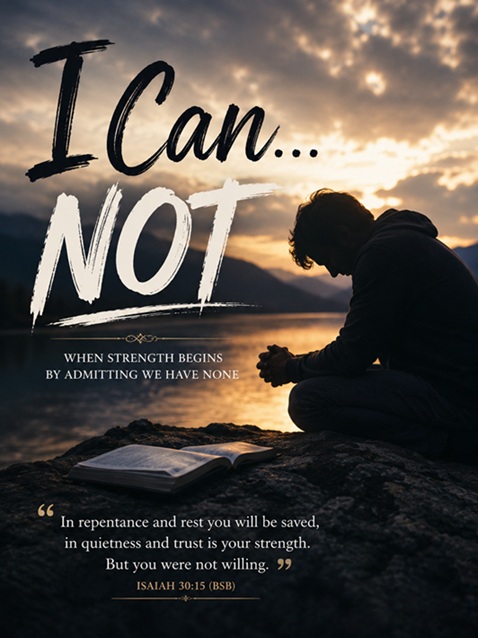
“In repentance and rest you will be saved, in quietness and trust is your strength.” (Isaiah 30:15 BSB)
How can silence defeat what force could not? How can resting accomplish what endless striving never could? How can trusting God become greater than fighting in your own strength?
This is not the world’s mathematics.
The world says do more. God says come to Me. The world tells us to become stronger. God invites us to become dependent. The world applauds self-confidence. Christ blesses the poor in spirit.
But read what follows that promise in Isaiah. God had just offered His people the most counterintuitive path to victory — rest, quietness, trust — and their response was devastating in its familiarity.
“But you were not willing.”
They were not willing to stop striving. They were not willing to be still. They ran instead to Egypt, to horses, to human alliances — anything that felt more like action, more like strength, more like control. And God watched them run toward the very things that would not save them, because the one thing that would save them required something they were not yet willing to do.
Admit they could not do it alone.
The Strength That Comes Before the Storm
Perhaps no one understood this more quietly than Jesus Himself.
Before the crowds. Before the opposition. Before the weight of the cross. Jesus withdrew. Not occasionally — consistently. “But Jesus often withdrew to lonely places and prayed.” (Luke 5:16 NIV) He did not rush from one demand to the next, drawing on reserves of personal strength. He returned, again and again, to the source.
The night before He chose His twelve disciples, He spent the entire night in prayer on a mountain (Luke 6:12). Not strategizing. Not preparing speeches. Praying. The most consequential decision of His earthly ministry was preceded not by confidence in His own judgment, but by communion with His Father.
And in Gethsemane, on the night before the cross, He did not stride toward Golgotha fueled by self-determination. He knelt in the dark, sweat falling like drops of blood, and asked the Father to sustain Him through what love had chosen. He rose from that ground not because the weight had lifted, but because He had found — in quietness and trust — the strength to carry it all the way to the end.
His strength was never found in hurried activity. It was found in perfect dependence.
When Peter Stopped Sinking and Started Drowning
Peter understood the pattern of self-reliance better than most, because he lived it loudly.
He was the one who said “I will never disown you” — with full sincerity, in the same breath as the other disciples, yet somehow louder and more certain (Matthew 26:33-35 NIV). He was the one who drew the sword in the garden, ready to fight the entire Roman guard on his own. He was the one who stepped out of the boat and walked on water — until he looked at the waves and remembered he was just a fisherman.
“But when he saw the wind, he was afraid and, beginning to sink, cried out, ‘Lord, save me!'” (Matthew 14:30 NIV)
Three words. Lord, save me. Not a strategy. Not a recovery plan. Just the honest cry of a man who had run out of self and found, in that exact moment, the beginning of real faith.
Jesus reached out immediately and caught him. Not after Peter had composed himself. Not after he had processed what went wrong. Immediately, in the middle of the sinking — the hand was already there.
Peter’s greatest moments were never the ones where he relied on his own strength. They were the ones where his strength ran out and he reached for something greater. The boldness that would later carry the gospel across the known world was not built on Peter’s confidence. It was built on what Peter learned when his confidence failed him.
You do not learn dependence in calm water. You learn it when you are sinking and the only voice that matters is the one saying “take My hand.”
The Road Home That Starts With Admitting You Are Lost
The prodigal son did not return home in strength. He returned in ruin.
He had left with confidence — certain that his own wisdom, his own freedom, his own choices would lead somewhere worth going. He had the inheritance in his hands and the horizon in front of him. He was sure he could handle it.
“After he had spent everything, there was a severe famine in that whole country, and he began to be in need.” (Luke 15:14 NIV)
And it was in that need — sitting in a pig pen, hungry enough to envy what the animals were eating — that something broke open in him. Not dramatic. Not triumphant. Just a quiet reckoning with the truth he had been avoiding: I cannot do this. I have run out of everything I thought I had.
“When he came to his senses, he said, ‘How many of my father’s hired servants have food to spare, and here I am starving to death! I will set out and go back to my father and say to him: Father, I have sinned against heaven and against you. I am no longer worthy to be called your son; make me like one of your hired servants.'” (Luke 15:17-19 NIV)
He did not go home as a son. He planned to go home as a servant. He had surrendered every claim, every title, every right to be received as anything more than what his choices had made him.
And his father ran to him before he could finish the speech.
The confession — I cannot, I am not worthy, make me a servant — was the very thing that brought him home. Not to servanthood, as it turned out. To sonship restored. To a robe and a ring and a feast. Because the father was not waiting for his son to arrive strong. He was waiting for his son to arrive.
What I Cannot Taught Me
For years I believed I was stronger than temptation. I told myself my will was enough — that my convictions were solid, my conscience firm, my determination sufficient. I whispered to myself quietly, I can.
Then the battle came. And came again. Each time I fought harder, more resolved, more certain that this time would be different. Each imagined victory was followed by another fall. What I thought was strength slowly exposed my greatest weakness.
Sin was never meant to teach me how strong I am. It was meant to show me how desperately I need my Savior.
The moment I stopped saying I can and started saying I cannot — something shifted. Not in the battle. In me. Because when I finally admitted I cannot overcome this enemy alone, I stopped being the center of the fight. And when I stopped being the center, there was finally room for the One who could actually win it.
“I cannot silence temptation by my own willpower. I cannot rescue myself. I cannot return to You as a faithful son — but I will return as a servant. Only let me return.”
And strangely, that confession no longer sounds like defeat. It sounds like the beginning of faith. Because the moment I say I cannot, Christ answers quietly — I can.
The Strength Isaiah Promised
Quietness. Trust. Rest. Repentance.
These are not the weapons the world would choose. They look like weakness from the outside. They feel like surrender in the moment. But they are the exact posture that opens us to the strength that does not run out — the kind that carried Jesus through Gethsemane, that restored Peter on the beach, that met the prodigal at the end of the road before he could finish his apology.
The world will keep telling you to become stronger than your enemy. To discipline yourself into victory. To push through until you break the pattern by force.
But Isaiah knew something the world does not. Strength is not found in the striving. It is found in the returning. In the quietness. In the trust that says — I cannot, but You can, and I am finally done pretending otherwise.
That is where His strength begins.
And it has been waiting there the whole time.