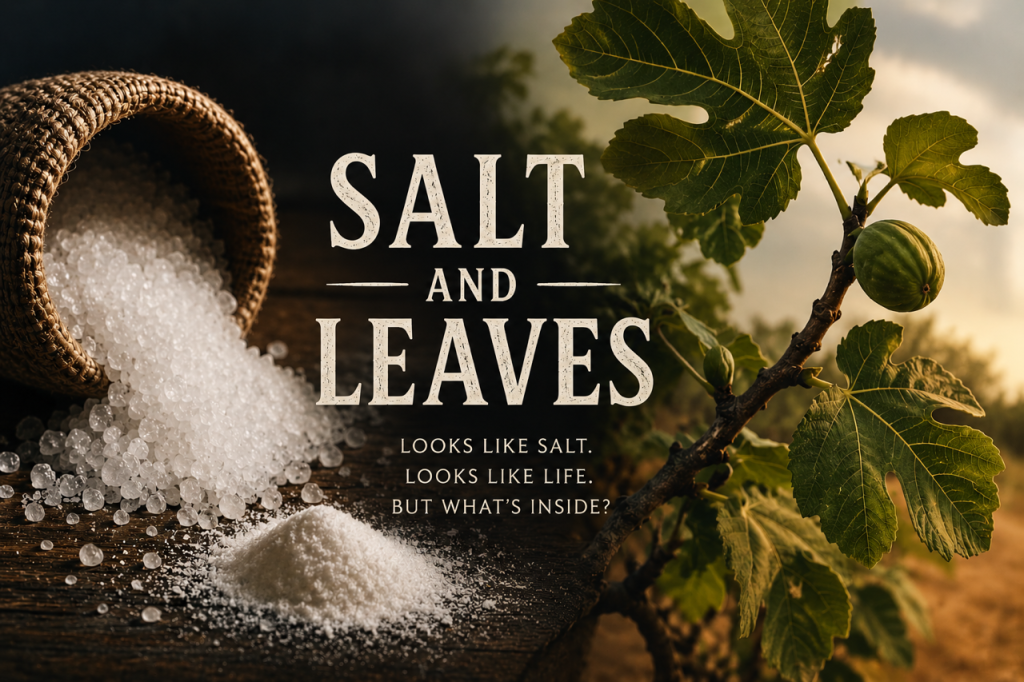
One of the most fascinating things about salt is this: scientifically, pure salt does not truly go bad.
Leave it sealed or open. Decades may pass. Moisture may harden it. Time may gather dust around it. But salt itself remains salt. It does not rot. It does not spoil. It does not suddenly forget what it was created to be.
Which makes Jesus’ words even more intriguing:
You are the salt of the earth. But if the salt loses its savor, how can it be made salty again? It is no longer good for anything, except to be thrown out and trampled by men. (Matthew 5:13)
At first glance, this sounds strange. How can salt lose its saltiness if salt, by its very nature, remains salt?
The Appearance of Salt
In Jesus’ time, salt was not the highly purified substance we find in grocery stores today. Much of it was gathered from the areas surrounding the Dead Sea, where it was heavily mixed with minerals, sand, and impurities.
Over time, moisture would slowly dissolve and wash away the actual sodium chloride—the true salt content. What remained was a pale, white residue. It still looked exactly like salt. It filled the container like salt. But it no longer carried its power. It could no longer preserve, season, or transform anything it touched.
Long before Jesus spoke those words on the hillside, God had already appointed a people to be salt to the nations. Israel was chosen not for superiority, but for purpose—a living demonstration that there was a God who was holy, just, and near. Through them, the whole earth was meant to taste something different.
But something happened along the way. The law given to free them became a cage they built around themselves. They studied the Word so carefully that they stopped living inside it. They counted every letter. They measured every Sabbath. And yet, when the very Word they had memorized walked among them in the flesh, stood in their synagogues, and spoke—they could not recognize Him.
The Apostle Paul would later write the devastating diagnosis:
And He has qualified us as ministers of a new covenant, not of the letter but of the Spirit; for the letter kills, but the Spirit gives life. (2 Corinthians 3:6)
Let us be honest. This is not a failure unique to one generation; this is a collective human vulnerability. We are all capable of taking the living fire of God and building a religion around it that keeps us warm without ever letting it change us. We follow in the very same footsteps more often than we would like to admit.
The Treasure Inside
Jesus understood where the real problem lived. Not in the law, nor even in the religious system, but in the heart.
The good man brings good things out of the good treasure of his heart, and the evil man brings evil things out of the evil treasure of his heart. For out of the overflow of the heart, the mouth speaks. (Luke 6:45)
The salt was always meant to flow outward from the inside. But when the inside is compromised, the flavor dies before it ever reaches anyone else. You cannot give what you no longer carry.
Think of a child. They are born with a natural purity—an original moral instinct not yet buried. If they do something good and you notice it, they get absolutely thrilled, shining with a natural joy. If they do something wrong, even without anyone telling them, something instantly shifts inside. They carry an innate sensitivity. The salt is already there, pure and active.
But then the world begins its patient, daily work. Layer by layer, that original purity gets covered over by hurt, disappointment, and the relentless pressure of culture.
What makes it worse is that we often reach for religion merely to dress up those same human constructs in Christian language. We take our comfort zones, our ambitions, and our need for control, and we label it “faith.” We build structures that look exactly like salt, but the sodium chloride has long since washed out.
The image is there—we go to church, post inspirational verses, and maintain a clean appearance—but the actual power to preserve morality, to bring the flavor of Christ into a room, to convict, and to transform is completely missing.
Leaves Without Fruits
This dilution of the soul brings another sobering image from Scripture into focus: the barren fig tree.
Seeing in the distance a fig tree in leaf, He went to see if there was any fruit on it. But when He reached it, He found nothing on it except leaves, since it was not the season for figs. (Mark 11:13)
Jesus approached the tree expecting nourishment because, from a distance, it appeared full of life. It had vibrant green leaves everywhere. Yet, Jesus didn’t just walk past the tree; He cursed it. Why such a severe reaction?
Because with fig trees, the fruit is supposed to appear at the same time as the leaves. Green leaves are a promise of food. The tree was advertising something it could not deliver. It was a living lie.
God detests this because a deceptive appearance prevents a person from seeking the cure. If you believe your green leaves mean you are healthy, you will never realize your roots are rotting.
The Slow Suffocation
In another parable, Jesus told a story about a farmer who scattered seed, and some fell among thorns. The seed didn’t fail, and the plant actually began to grow. But then—quietly, gradually, without a single dramatic moment—the thorns crept in and choked it.
but the worries of this life, the deceitfulness of wealth, and the desire for other things come in and choke the word, and it becomes unfruitful. (Mark 4:19)
This is the exact image of our generation. We have not abandoned faith dramatically; we have simply drifted. We are slowly suffocated by notifications, noise, the next thing to buy, and the next thing to fear. The plant of faith is fighting for light it can barely reach.
We are perhaps the most spiritually over-informed and under-formed generation in history. We have access to more sermons, more podcasts, and more Bible apps than any people before us. Outwardly, these resemble good offerings to God, but a crucial element is missing.
The Scriptures state:
And you shall season each of your grain offerings with salt. You must not leave the salt of the covenant of your God out of your grain offering; you are to add salt to each of your offerings. (Leviticus 2:13)
Among all the spiritual offerings we produce, if we do not have salt within to preserve them, the enemy of the Word will come and steal it, or plant weeds next to it to suffocate it before it can fruit. How do we bring forth true fruit? By obeying Jesus’ command to “have salt in yourselves.” Without it, we fall into the quiet confession of our age:
having a form of godliness but denying its power. Turn away from such as these! (2 Timothy 3:5)
Salted by Fire
For everyone will be salted with fire. Salt is good, but if the salt loses its saltiness, with what will you season it? Have salt among yourselves, and be at peace with one another.” (Mark 9:49-50)
Did you know that pure salt is entirely fire-resistant? It can withstand temperatures up to 1474°F (801°C). As a mineral, it is incredibly stable; it does not burn away like wood or oil.
Worldly trials may feel like a fire, but they cannot consume the divine salt within you. Instead, the flames only burn away the impurities, stripping the heavy layers to reveal what God originally planted in your soul. When Jesus instructed us to “have salt in yourselves,” He was calling us to be watchful. As we take steps toward Him—through every sermon heard and every spiritual awakening—we must have within ourselves what it takes (the salt) to preserve those moments, ensuring they take root and yield a lasting harvest.
What actually causes our salt to disappear is not the intensity of the trial, but our lack of watchfulness . When we stop guarding our hearts, the “small foxes” sneak in and spoil the field. This internal neglect causes the true salt to leach out.
Levitical teachings show that an offering is only acceptable if it is salted. Salt represents a preserved covenant and the internal willpower to act on your words. It keeps your promises securely rooted in your heart so you do not fall into a trap of empty declarations.
The Price of Flavor
Here is what is rarely discussed about salt: for it to truly flavor what it touches, it must dissolve. It must give itself up entirely. A grain of salt that refuses to dissolve flavors nothing. It sits on top of the dish, completely visible and intact, contributing nothing to the final outcome.
We often talk about being salt as though it is a position to occupy or a prestigious title to hold. But the true image of salt is not about standing out; it is about dissolution. It means giving yourself so completely to the people around you that your patience becomes their calm, your faith becomes their courage, and your joy becomes their permission to hope again.
This is where the ego breaks down. The pride that wants credit, the self that wants to be seen doing the salting—all of it must fade. Real salt does not need to be observed. It disappears and transforms from the inside out. When the “I” dissolves, the world tastes a grace it cannot logically explain.
The Promise to the Saltless
What about the person reading this who recognizes the leaching within their own soul? Who clearly sees the thorns that have grown quietly, and sits with the honest awareness that their inner flavor has grown faint?
Jesus did not send a word of final condemnation. He sent each of us a knock at the door:
Behold, I stand at the door and knock. If anyone hears My voice and opens the door, I will come in and dine with him, and he with Me. (Revelation 3:20)
When we open that door, look at what the Lord does, just as He did through the prophet Elisha at the spoiled waters of Jericho:
and Elisha went out to the spring, cast the salt into it, and said, “This is what the LORD says: ‘I have healed this water. No longer will it cause death or unfruitfulness.’” (2 Kings 2:21)
The salt may have leached out of your life. The thorns may have grown tall. But as long as there is breath and a genuine willingness to ask, the promise of the Master Restorer stands completely firm:
Ask, and it will be given to you; seek, and you will find; knock, and the door will be opened to you. (Matthew 7:7)
He does not require a flawless performance before He restores your soul. He requires only a posture—an open hand, a turned heart, and an appetite for reality.