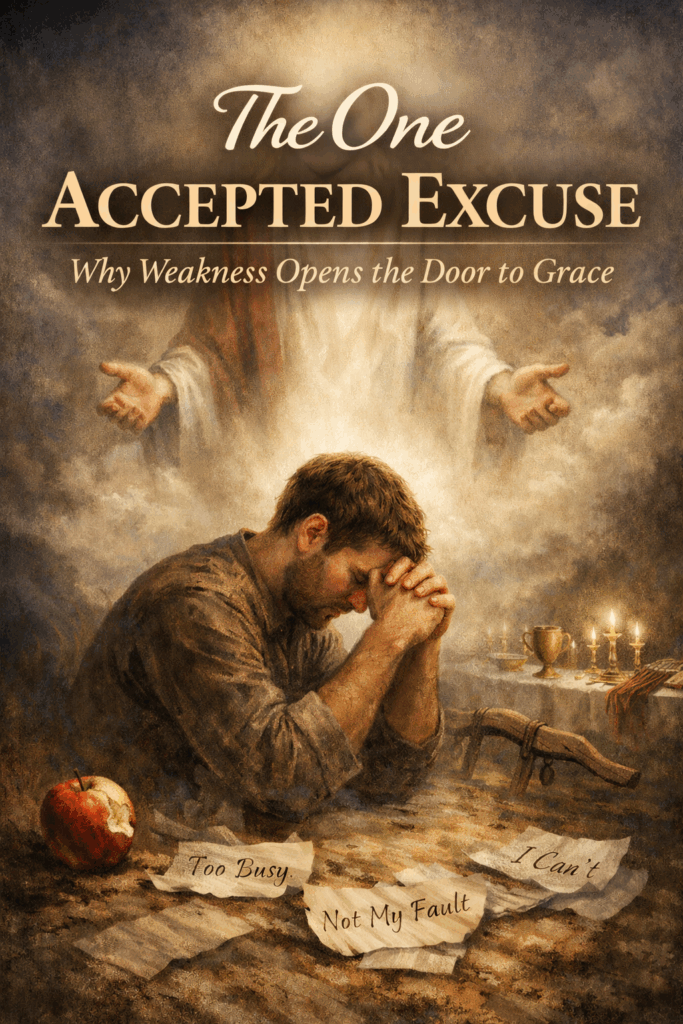
When Weakness Becomes the Path to Grace
There is something almost natural in us: when we fall, we explain ourselves. We gather our reasons like a bundle in our arms and carry them before God: “It was hard… I was tired… I was wounded… everyone else does it… circumstances forced my hand… this temptation is everywhere.”
We are not usually trying to lie; we are trying to protect ourselves from shame.
This habit is ancient. When Adam stood before God in the garden after his disobedience, he did not say, “I have sinned.” He said, “The woman whom You gave to be with me, she gave me of the tree” (Genesis 3:12). His words sounded logical—even understandable. But they quietly pushed responsibility away from the heart and onto circumstances, people, and even God Himself. The excuse created distance instead of healing.
Ever since, humanity has become skilled at explaining failure—but heaven is not moved by explanations. Heaven opens to truth. Excuses may sound harmless, but they reveal something deeper: a heart that has not yet bowed in humility.
So Christ walks the long road of human history like a patient visitor, moving from door to door, knocking and saying: “Behold, I stand at the door and knock…” (Revelation 3:20). He is listening not for polished reasons, but for one honest confession:
“Lord, I am weak.”
Not spoken casually, but spoken from the depth of the heart. Let us follow along to see how those who won grace actually arrived there.
Gideon: The Door of Smallness
Along the road, Jesus pauses before the door of a man who is in hiding. Gideon is threshing grain inside a winepress—not because it makes sense, but because it keeps him invisible. Enemy raiders have been stealing crops year after year, and survival has trained him to stay unnoticed and quiet.
When the angel greets him as a “mighty man of valor,” Gideon almost protests. He answers honestly:
“My clan is the weakest in Manasseh, and I am the least in my father’s house” (Judges 6:15).
He essentially said, “Lord, I am weak.” Instead of correcting Gideon’s self-image, God offers something more stable than confidence—His presence: “Surely I will be with you.” Gideon will still feel small tomorrow, but he will no longer face tomorrow alone.
Solomon: The Door of Inexperience
Another door opens to a young king overwhelmed by responsibility. Having inherited the throne of David, the king who brought Israel glory, Solomon can only utter, “Lord, I am weak.” He acknowledges his lack of wisdom to govern a great nation.
Solomon confesses his shortcomings before God:
“I am but a little child; I do not know how to go out or come in” (1 Kings 3:7)
It is the prayer of someone who knows that leadership without wisdom becomes damage. God receives that honesty gladly. Wisdom flows—not merely intelligence, but discernment, restraint, and the ability to listen deeply. Solomon does not become independent; he becomes guided.
Nineveh and Babel: Two Cities, Two Doors, Two Directions
Jesus walks not only through individuals doors, but through entire communities.
Nineveh was a city that did not know God. It was corrupt and spiritually blind. Despite not worshipping the God of Israel, they listened to His warning. They didn’t make excuses; instead, they cried out, “Lord, I am weak.” From the king down to the lowest servant, they humbled themselves, fasted, and changed their ways. Their repentance wasn’t perfect, but it was genuine. God responded to their humility with mercy.
Babel, however, represented a different spirit. Instead of saying, “Lord, I am weak,” they moved in self-sufficiency. Its people were organized, skilled, and ambitious. They built upward in self-confidence, saying, “Let us make a name for ourselves” (Genesis 11:4). But strength disconnected from humility fractured into confusion. Progress without surrender lost its coherence.
Jeremiah: The Door of Fear
Jesus pauses before the door of a young man whose life is still unformed. His voice trembles when he speaks. He knows his limitations, his awkward speech, and his sensitivity to rejection. When God calls him to confront a nation, his heart cries:
“Ah, Lord God! Behold, I cannot speak, for I am a youth” (Jeremiah 1:6).
God does not shame him for his fear; He promises His presence. He tells Jeremiah that strength will not come from personality, but from divine companionship. Jeremiah does not suddenly become fearless, but he becomes carried. And carried weakness proves stronger than isolated strength.
The Garden: The Door of Human Fragility
Jesus steps into the quiet of Gethsemane to knock on the door of His closest friends. They are asleep while He carries the weight of His coming suffering. They had promised loyalty and meant well, but exhaustion overtook intention.
Our bodies tire. Our emotions fluctuate. Even sincere love grows thin under pressure. Jesus is not offended by this reality; He understands it from the inside. He waits not for perfection, but for the voice saying, “Lord, I am weak.” He names the human condition with mercy:
“The spirit indeed is willing, but the flesh is weak” (Matthew 26:41).
Two Men in the Temple: Pride vs. Need
At the door of the Pharisee—disciplined and respected—the man stands confidently and thanks God for his virtue (Luke 18:11–12). It is as if he is saying, “Lord, I am NOT weak” . His prayer is not false, but it is sealed. There is no room for mercy because he already believes himself full.
Nearby, another door cracks open: the door of a tax collector. He cannot even lift his eyes. His heart says, “Lord, I am weak,” and his lips utter: “God, be merciful to me, a sinner!” (Luke 18:13). Jesus says this man leaves justified and healed.
Paul: The Door That Never Closed
Even Paul, whose prayers healed the sick and whose letters shaped the Church, carried a weakness that refused to leave. He pleaded for its removal, but Christ offered a deeper gift:
“My grace is sufficient for you, for My power is made perfect in weakness” (2 Corinthians 12:9).
Paul learned that weakness preserved dependence. It guarded humility. He didn’t just say, “Lord, I am weak,” he delighted in it:
“For when I am weak, then I am strong” (2 Corinthians 12:10).
The Great Banquet
Christ tells us of those invited to a great banquet. Each had a reason not to come—land to inspect, oxen to test, a marriage to attend (Luke 14:16–20). None of these reasons were sinful in themselves, yet all were unacceptable because they placed the gift above the Giver. If we truly understood that all our needs are met in God’s presence, we would never favor an excuse over Him.
The Warning: Sincerity vs. Hypocrisy
But let us be clear: This is not permission to remain in sin. It is not a formula to quiet our conscience or a phrase to repeat while planning to fall again.
God knows the depths of the heart. If we say, “I am weak” while secretly clinging to sin, we deceive only ourselves. But if we say, “I am weak—and I do not want to be weak anymore. I need Your strength,” then grace rushes in. True repentance is the cry:
“Lord, be my strength,
for I do not want to be this way anymore.”
Conclusion
If you want to stand before God today and know you are accepted, put away the excuses of Adam. Stop blaming your spouse, your job, your childhood, or the state of the world. Stand before Christ and simply say:
“Lord, I have fallen again because I am weak. I have no excuse, only a need for Your mercy. You said Your strength is made perfect in my weakness—so come, Lord, and be strong in me.”
The moment we stop defending ourselves, God begins to defend us. The moment we stop trying to be “powerful,” we become candidates for His Divine Power.
A broken and contrite heart, O God, You will not despise (Psalm 51:17).
? A Closing Prayer
Today, do not stand before God with explanations. Stand before Him with truth.