We live in a world that demands an explanation for everything. Our minds are restless—constantly searching for reasons, patterns, and logic. When we see the impossible—like a man walking on water—we immediately look for the hidden platform beneath the surface. We are designed this way. God gave us minds that thirst for understanding and hands that itch to innovate. The harder the mind works to understand the illogical, the more inventive it becomes.
Yet there is a sacred threshold where the mind ends—and the Spirit begins.
The Heart of Faith
God does not want only our intellectual agreement; He desires our hearts. Sometimes, He speaks a promise that feels completely irrelevant to our current storm. When He says, “Come to Me, and I will give you rest,” we look at our schedules, our anxieties, and our five senses and ask, “How?”
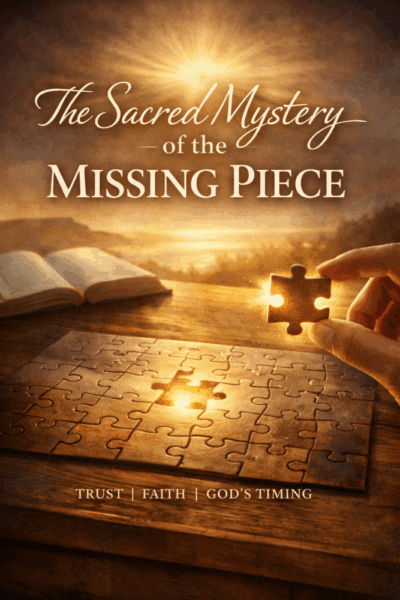
It feels like staring at a massive puzzle with a gaping hole in the center. We often mistake this missing piece for an error, a delay, or even cruelty.
Perhaps the mystery itself is part of the design. Maybe the puzzle cannot come together unless we first acknowledge that there are things we do not understand. Maybe Jesus wants us to remember his words.
“Truly I tell you, unless you change and become like little children, you will never enter the kingdom of heaven. “Matthew 18:3 NIV”
He revealed something profound. For a child, the how is not a mystery that demands solving. A child focuses on the destination, trusting the grown-up to handle the details.
God asks us to believe in what we may not understand now, trusting that understanding will come later. Belief is not ignorance—it is trust ahead of comprehension. By trusting, we give God room to work. And in time, the picture becomes clearer. Maybe now we hear the echo of Jesus’ voice:
“You do not realize now what I am doing, but later you will understand. ”John 13:7"
When we try to complete the puzzle without Him—depending only on our senses—we often create detours in our lives. We know mathematically that a straight line is the shortest path, yet our minds convince us to choose other routes because they feel safer, more comfortable, or less frightening than the unknown straight line.
“Trust in the Lord with all your heart and lean not on your own understanding; in all your ways submit to Him, and He will make your paths straight.” Proverbs 3:5–6 "
The Father’s Paternal Love
God is not trying to make your life difficult. He is a Father who wants to remain in the room with you, because only in His presence do the puzzle pieces come together with peace.
When we demand all the pieces at once so we can do it “by ourselves” we often grab everything, retreat into a corner, and stare at the chaos in our hands—confused, overwhelmed, unsure where to begin. The pieces multiply, but the picture remains broken.
In His paternal love, God keeps the pieces in His hand and gives us only what our minds can handle. He allows us to experience progress—real growth—by placing pieces into our vision slowly, so we can feel the joy of completion without being crushed by the weight.
God understands our human nature. He does not require blind faith without context. That is why He gave us history—stories of others, and reminders of our own lives—times when He delivered us before. He asks us not to believe Him blindly, but to believe Him because of what He has already done.
The Narrow Road and the Missing Piece
Is this the narrow road that few can find—the one Jesus spoke about? Could it be that our minds are constantly drawn to the one missing piece, the one unanswered question? Have you ever considered that God may have allowed it to remain missing on purpose?
When we try to solve the puzzle on our own, God may allow it—not because it is best, but because love honors freedom. Yet freedom without guidance can lead us away from the straight path.
Let us look at the lives of the great saints—those the Bible and the world consider giants of faith. They were human like us, often fixated on the missing piece, trying to complete the puzzle with their own hands.

Learning from the Father of Faith: Abraham
Abraham is celebrated for his faith—the man willing to offer Isaac, the son he loved, trusting God completely. He believed that even if Isaac were sacrificed, God would somehow return him alive. The how was a mystery, but his trust was firm.
Yet this faith did not begin fully formed.
Years earlier, Abraham struggled while waiting for the promise. God promised a son through Sarah, but time passed. The missing piece felt unbearable. So Abraham tried to help God. He had a son through Hagar, Sarah’s servant. The plan succeeded—but created pain and division he never intended.
Later, Abraham faced another missing piece when he entered Egypt. Afraid the king would kill him to take Sarah for her beauty, he lied and said she was his sister. His attempt at self-protection created a greater danger because the Egyptian prince took Sarah to be his wife—but God intervened immediately, punishing the prince, who in fear returned Sarah unharmed to Abraham.
God is both Father and Master. He watches as we try to fit the pieces together. Sometimes He allows us to experience both good and bad. If danger becomes imminent, He intervenes quickly. Other times, He allows delay so we learn to seek His guidance.
Learning from Moses: Patience Through the Wilderness
Before he was the great Lawgiver, Moses was a man who tried to force God’s timing with violence. He saw the suffering of his people and, instead of waiting for God’s hand, he took a life in anger and fled into the desert; he was spontaneous and patient had no place in his mind. He spent forty years thinking his story was over—that he was just a shepherd who had failed his calling.
But God used those forty years in the wilderness to strip away Moses’ pride and teach him the patience of a shepherd. When Moses finally stood before the burning bush, he was weak and trembling, saying, “I am not eloquent.” It was only then, when Moses stopped trying to be the hero, that God could use him to part the Red Sea. God turned a fugitive into a liberator.
Learning from Elijah: From the Heights of Fire to the Depths of Despair
Elijah saw God do the impossible—calling down fire from heaven to defeat the prophets of Baal and killing all of them in one challenging day. Yet, shortly after, a single threat from a queen sent him running into the desert, praying for death. He was exhausted, lonely, and convinced he was the only faithful person left.
God did not scold Elijah for his depression. Instead, He sent an angel to give him food and water, and then He spoke in a “still, small voice.” God showed Elijah that His work continues even when we feel like we are falling apart. He gave Elijah a helper (Elisha) and a new mission. God turned Elijah’s burnout into a lesson on His gentle, sustaining presence.
Learning from Peter: From Failure to Foundation
Peter was bold and impulsive. He promised never to leave Jesus. He even drew his sword in defense. Yet, in the cold courtyard on that same night of the crucifixion, his courage failed him three times.
Ashamed, Peter returned to fishing, believing his puzzle was forever broken.
But the risen Christ met him—not with condemnation, but with a meal. Jesus asked, “Do you love Me?” three times—once for each denial. God transformed Peter’s greatest failure into humility and empathy. The fearful man became a bold witness. Cowardice became the foundation of stone.
The Beauty of Slow Work
God can intervene in an instant—but when it comes to your character, salvation, and eternity, He often takes time. Trees that grow too fast have shallow roots.
True open-mindedness is not knowing everything—it is accepting that others may see what you cannot. We complete each other, and God alone completes the whole.
The narrow road is not a path of perfect understanding—it is a path of perfect trust. If a piece of your life feels missing, do not harden your heart against the Designer. He is not hiding it to tease you; He is holding it to protect you.
The Heart of the Lesson
In every story, the saints stumbled. They tried to fix things alone. Yet God restored what they thought was ruined. Our weakness is not an obstacle—it is often the stage for His glory.
Like a master potter, God reshapes broken clay into something new. His question remains the same: Do you love Me?” If so, then believe me when I say to you
And we know that in all things God works for the good of those who love him, who have been called according to his purpose. “Romans 8:28 NIV”